
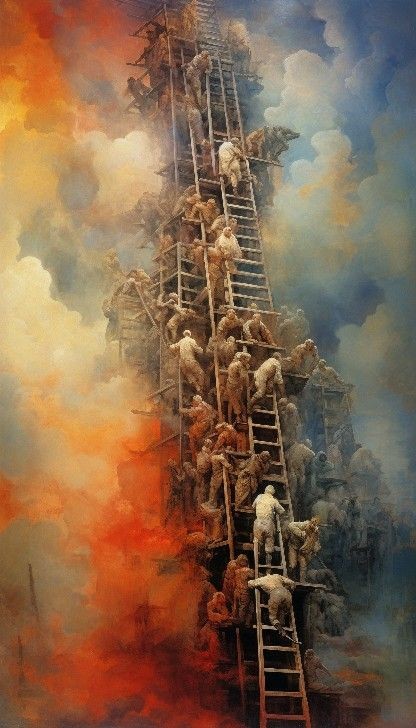
Ace History Desk – The sky in the northern hemisphere had been darkened, the winters unusually harsh, and the summers barely arrived for decades when the German Lutheran author Johann Arndt published his Four Books on True Christianity in 1610. Arndt warned his readers that:

when the sky burns like this, and the sun turns blood-red, it is telling us: Behold, one day I will perish in fire. In this way, all the elements speak to us, announcing our wickedness and punishments.
Although an extremely popular work of Lutheran devotionalism, Arndt’s book was considered unorthodox. It contained little of Luther’s theology and much alchemical philosophy. He heavily borrowed from the Swiss alchemist Paracelsus, often excerpting large portions of Paracelsus’s writings without proper attribution. By doing this, Arndt infused early modern Protestantism with a strong element of Hermetic philosophy, which posits that God is actively present within creation itself. This perspective has roots in the ancient Mediterranean world. It is notably absent from orthodox Lutheranism, where the cosmos is viewed as a fallen realm of mere matter, and divine knowledge is said to be accessible only through scripture. For his audience, Arndt’s book on alchemical Christian devotion appears to have provided a comforting explanation for the troubling changes in their climate.
Environmental historians and climate scientists have identified the 17th century as a critical phase of significant climate perturbation, marking the zenith of the Little Ice Age—a pronounced cooling interval spanning the late 16th to the late 18th centuries. During this epoch, average annual temperatures in the Northern Hemisphere plummeted by as much as two degrees Celsius. While this temperature decrease may seem marginal, its local implications were profound and far-reaching.
The 2015 Paris Climate Accords aimed to “hold global temperature increase to well below 2°C,” underscoring the recognition that surpassing this threshold may trigger irrevocable ecological and societal crises. Historical documentation from the coldest segments of the Little Ice Age provides valuable insights into the ramifications of similar climatic extremes. Scholars like Geoffrey Parker have commenced analyses of this epoch’s socio-cultural and historical ramifications, encompassing diverse regions from the Americas to Europe and Asia. Key consequences included widespread crop failures precipitating food scarcities, fostering social unrest, and military conflicts. Thus, the global upheaval of the 17th century can be understood as a direct consequence of the climatic extremes experienced during the climax of the Little Ice Age.
For many individuals during the Little Ice Age, extreme weather events were interpreted through a theological lens, prompting a need for divine explanation. The religious literature of 17th-century Europe reflects the lived experiences of the populace as they sought to rationalise environmental upheavals. Among the prominent figures of this era, Johann Arndt distinguished himself, particularly within Protestant circles, with his writings achieving remarkable popularity—so much so that they reportedly surpassed Bible sales in some areas of Germany. Arndt’s works directly addressed the unique environmental challenges posed by the Little Ice Age, supplying a spiritual framework to understand phenomena overlooked mainly by mainstream Lutheran doctrine.

A particularly concerning phenomenon was the significant darkening of the upper atmosphere across the northern hemisphere. A notable increase in volcanic activity globally released substantial quantities of sulphur dioxide into the stratosphere, resulting in a persistent reduction in solar irradiance over several decades. This atmospheric phenomenon likely exacerbated already low temperatures, creating a challenging environment for agriculture. For communities reliant on solar energy for crop production, the visual cues of this atmospheric dimming were foreboding, while the agricultural impacts were devastating, leading to marked declines in yields.
Arndt put forward the obvious interpretation: ‘When one now looks at the darkness of the sun and the moon, one should think that … it is contrary to their nature, and proclaims to us a great wickedness performed on earth.’ The dimming of the skies and the celestial bodies that reside there, he argued, must have been the result of some human moral failure. This was a conclusion that could not have been reached through orthodox Lutheran doctrine, which held that divine knowledge can only be found in the scriptures and not through environmental phenomena.
Similar interpretations of climate change during the period led to tragic instances of scapegoating. In southern Germany in 1626, a spring hailstorm followed by sudden Arctic temperatures prompted the swift and horrific torture and execution of 900 men and women accused of creating the storm by witchcraft.
Arndt, for his part, did not attempt to blame vulnerable groups. Instead, he presented an ecological vision in which humans and the cosmos were in intimate interrelation, suffering together even as they did so as a result of human moral failure:
The suffering of the macrocosm, the great world, is subsequently fulfilled in the microcosm, that is, in humanity. What happens to man, nature, and the great world suffer first, for the suffering of all good and evil creatures is directed towards man as a centre where all circle lines converge. For what man owes, nature must suffer first.
These radical religious writings and their intense popularity reveal an early modern reading public intent on interpreting and understanding their changing environment. Arndt’s book permanently transformed Protestant Christianity and its relationship with the physical world by shuttling Hermetic perspectives on the cosmos’s divinity into a Europe desperate for a religious understanding of their changing climate.
At Sterling Publishing & Media Service Agency, we value transparency and accountability. We want to inform you that we are not responsible for any external content, links, or posts. Nonetheless, we are dedicated to providing exceptional services and sincerely appreciate your support. Thank you.