


#AceNewsReport – Feb.16: The diplomatic possibilities are far from being exhausted … It should be possible to find a solution,” he said.
#AceDailyNews UPDATE on The Ukraine Crisis: Putin names his price for peace in Ukraine: Russian President Vladimir Putin has said war can be avoided if Ukraine and the West issue a cast-iron pledge never to allow Ukrainian membership of NATO, signalling his readiness to “go down the negotiations track”
Kindness & Love❤️❤️ says we are sending 🙏’s to all citizens for PEACE & NOT War Amen

AFR – Hans van LeeuwenFeb 16, 2022 – 1.15pm, first published at 4.51am
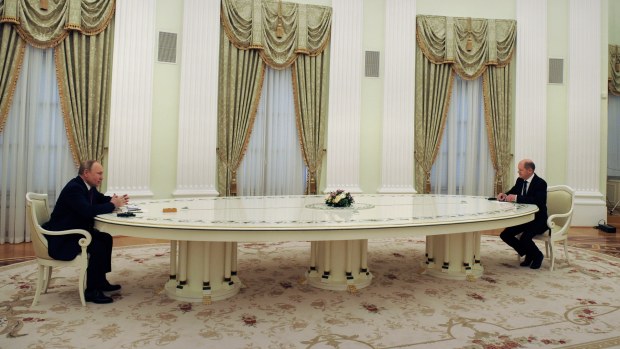
German Chancellor Olaf Scholz, standing next to Mr Putin after a make-or-break meeting in Moscow on Tuesday (Wednesday AEDT), said although NATO and the EU did not agree with Russia’s demands, “there are some points in there that are worth discussing”.
The constructive noises from the Scholz-Putin talks build on signals from the Kremlin – reconfirmed by Mr Putin on Tuesday – that Moscow is about to withdraw some of its forces from the border, raising hopes of a peaceful climb-down from the brink of a Russian invasion.
But even as the talks were going on, a cyber attack was reported on Ukraine’s defence ministry and two of its banks, which Kyiv said could be Russian handiwork.
And NATO secretary-general Jens Stoltenberg said the alliance saw no evidence yet of any pull-back of troops, which were still “in place for an attack”. But he said the Kremlin’s announcement “gives grounds for cautious optimism”.
US President Joe Biden said reports some Russian forces had withdrawn were welcome, but they were unverified and an invasion remained a possibility.
Some analysts say Mr Putin could be playing a double game, appearing to pursue peace so that an invasion – in response to a staged provocation inside Ukraine – would look less bellicose and blameworthy.
Still, European sharemarkets rallied more than 1 per cent, and Moscow’s benchmark was up more than 3 per cent, as investors took the leaders’ words at face value. And British Prime Minister Boris Johnson also welcomed “a Russian openness to conversations”.
Donbas difficulties
The meeting between Mr Putin and Mr Scholz suggests the focus of talks may now switch to the Minsk accords, which France and Germany brokered with Russia and Ukraine in 2014-15.
Those accords have foundered because the two protagonists interpret them differently. In Kyiv’s view, the deal is that Ukraine regains the breakaway provinces of Luhansk and Donetsk in exchange for some devolution of administrative functions and political power.
But Moscow sees reunification as conditional on the two provinces – which together form the Russian-speaking Donbas region – getting special autonomous status.
On Tuesday, Russia’s Parliament tabled a motion calling on Mr Putin to recognise the independence of Donetsk and Luhansk. Asked to do so at his press conference with Mr Scholz, he refused.
He said he would do “everything we can to solve the problem” of the war-torn Donbas region, but this should be “based on the possibilities enshrined in the Minsk agreements that have not been implemented”.
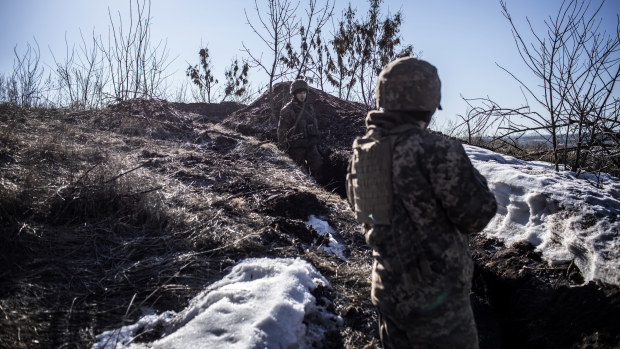
Yet Mr Putin also dangled the possibility of using Donbas as a pretext to invade, saying “human rights violations” were taking place there.
Still, Mr Putin and Mr Scholz, like French President Emmanuel Macron, have opened the door to resuming the four-country “Normandy Format” negotiations that produced the Minsk accords.
Mr Putin said: “We are ready to work further together, we are ready to go down the negotiations track.“
Mr Scholz said: “For Europeans, it is clear that lasting security cannot be achieved against Russia, but only with Russia.”
NATO sticking point
But the Minsk accords do not cover Ukraine’s potential NATO membership, which is an avowed goal of the country’s constitution.
“NATO expansion is not really on the agenda,” Mr Scholz said.
But Mr Putin said that even if NATO was not ready to admit Ukraine today, that didn’t rule out the possibility forever.
“Will Ukraine be accepted, when it is ready? It may be too late for us then. We need to resolve this now,” he said.
“This is our position, and we hope very much that our concern will be heard by our partners and taken seriously.”
Mr Scholz had been in Kyiv on Monday, and there is speculation he may be putting pressure on Ukrainian President Volodymyr Zelenskyy to make concessions that would get Moscow off Ukraine’s back.
Mr Zelenskyy said Ukraine still aspired to NATO membership, but it was a far-off dream, and “the decision to join NATO depends not only on our country”.
He also signalled a willingness to discuss “guarantees”, embedded in European security arrangements, that might ensure Ukraine’s territorial integrity.
But his spokesman on Tuesday said Kyiv doubted Russia was acting in good faith, and was sceptical about the Kremlin’s claims to be withdrawing troops from their encirclement of Ukraine – a position echoed by Mr Johnson.
“The intelligence we are seeing is not encouraging,” the British Prime Minister said.
“We’ve got Russian field hospitals being constructed near the border with Ukraine in Belarus that can only be construed as preparation for an invasion. You’ve got more battalion tactical groups actually being brought closer to the border.”
On Wednesday, NATO defence ministers will meet in Brussels, where they are set to discuss a plan to deploy new multinational battle groups in Bulgaria and Romania, and possibly also in Slovakia and Hungary, as part of a response to Russia’s militarism.
🌐 Russian State Duma backs resolution calling for recognition of Donetsk and Luhansk ‘people’s republics’ (later in the day, President Putin said his administration remains committed to the “not fully realized opportunities for the implementation of the Minsk agreements”)
👋 Russia announces withdrawal of some troops from Ukraine border after military drills (the announcement led to an immediate jump in the ruble and stock prices)
🕊️ (Opinion) Without nukes or Communism, Russia finally has a chance to avoid another doomed empire
In an essay for Russia in Global Affairs, Vatfor political center founder Sergey Poletaev argues that Moscow has an unprecedented level of freedom today to act internationally, thanks to its nuclear deterrent and the absence of any rigid ideology restraining the Kremlin. Poletaev also says Russia is in no position now to grow its influence or empire in Europe. Whenever such expansion weakens rather than strengthens a nation, he says, the empire will collapse under its own weight.
At the same time, recent experience in Syria, Afghanistan, and Kazakhstan shows that Russia can act outside its borders without triggering major Western responses. Moscow simply lacks the resources and the need to meddle in Europe, and the effort would only interfere with its own more important domestic agenda.
Elites in the West, says Poletaev, have concluded that containment defeated the USSR and can work again against the Russian Federation. While tensions with Russia are a peripheral concern to the West, revising the results of the Cold War remain inconceivable. The crisis has played out largely in information flows, where Poletaev says propaganda on both sides has “primitivized” perceptions, reducing much to Vladimir Putin as an individual. Inside Russia, the public sees the president as the nation’s lone defender. The West, meanwhile, demonizes Putin, believing that Moscow will retreat as soon as he’s gone.
If Russia backs away from Ukraine and let’s the West manage its many internal problems, it’s possible that the government in Kyiv could become a stable energy-transit partner, years from now, not unlike Poland or Belarus, where “permanent Russophobic escalation” and Alexander Lukashenko’s madman antics generally don’t get in the way of business.
The Kremlin, says Poletaev, should view NATO as an alliance that’s more “political-declarative than military-strategic” and ignore it. Constant confrontation with the West simply isn’t in Russia’s interests. Moscow should shore up its “satellites” in Belarus and the region’s various unrecognized republics, where little mafia states now terrorize the locals, who will eventually become susceptible to Western appeals Moscow abandons them to warlords. “At the moment, we should be quiet opportunists,” says Poletaev, arguing that Russians must “make time work for us.” With borders protected by nukes and the state free from Communism, the country can finally avoid its costly pursuit of deep borders and a European buffer zone.
#AceNewsDesk report ………….Published: Feb.16: 2022:
Editor says …Sterling Publishing & Media Service Agency is not responsible for the content of external site or from any reports, posts or links, and can also be found here on Telegram: https://t.me/acenewsdaily all of our posts fromTwitter can be found here: https://acetwitternews.wordpress.com/ and all wordpress and live posts and links here: https://acenewsroom.wordpress.com/and thanks for following as always appreciate every like, reblog or retweet and free help and guidance tips on your PC software or need help & guidance from our experts AcePCHelp.WordPress.Com

You must be logged in to post a comment.