
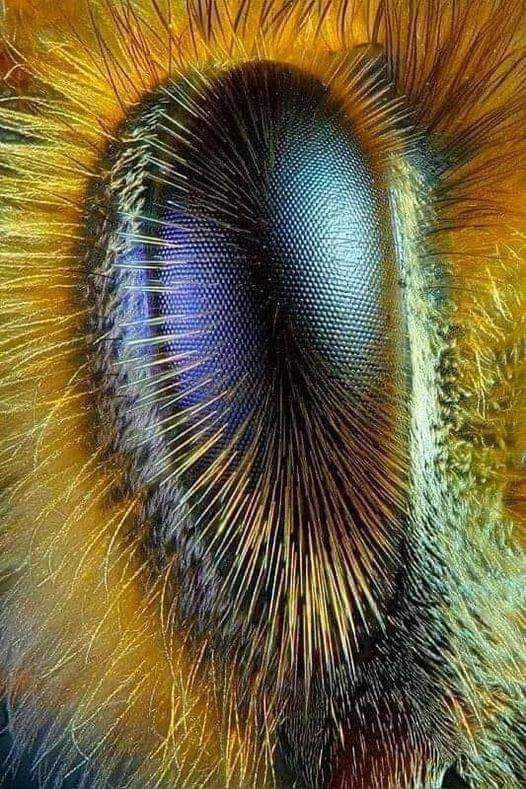
The Beeholder’s Eye
-The bee’s eye is a marvel of biology.
It is covered with hairs that act as a shield against pollen and consists of thousands of tiny lenses called ommatidia.
These lenses allow the bee to see various colours, including ultraviolet and are highly sensitive to movement.
This enables the bee to spot flowers and other sources of nourishment, as well as evade potential threats.
But what truly sets the bee’s eye apart is its structure.
Unlike our complex eyes, the bee’s eye comprises many simple eyes that work together to provide a wide-angle view of the world.
With a visual field of 280 degrees, the bee can see almost everything around it without turning its head.
This is particularly useful for locating flowers and avoiding predators.
In addition to its impressive visual capabilities, the bee’s eye processes information at lightning speed.
This helps the bee make swift decisions about where to fly and what to do, both essential for survival.
Overall, the bee’s eye is a crucial part of its anatomy and a testament to the power of nature.
It has developed over millions of years to help the bee thrive in its environment.

You must be logged in to post a comment.