

Amen 🙌🙏
There was a man who gave a great banquet…
Luke 14:15-24
One of those gathered round the table said to Jesus, ‘Happy the man who will be at the feast in the kingdom of God!’ But he said to him, ‘There was a man who gave a great banquet, and he invited many people. When the banquet came, he sent his servant to tell those invited, “Come along: everything is ready now.” But all alike started to make excuses. The first said, “I have bought a piece of land and must go and see it. Please accept my apologies.” Another said, “I have bought five yoke of oxen and am on my way to try them out. Please accept my apologies.” Yet another said, “I have just got married and so cannot come.”
‘The servant returned and reported this to his master. Then the householder, in a rage, said to his servant, “Go out quickly into the streets and alleys of the town and bring in here the poor, the crippled, the blind and the lame.” “Sir,” said the servant “, your orders have been carried out, and there is still room.” Then the master said to his servant, “Go to the open roads and the hedgerows and force people to come in to make sure my house is full because, I tell you, not one of those who were invited shall have a taste of my banquet.”’
Reflection on the painting
In the Gospels, particularly in Luke, Jesus is frequently found at the table. In today’s Gospel reading, He is a guest at a meal hosted by a prominent Pharisee, with other Pharisees and experts in Jewish law also present. One of the guests offers a beatitude, saying, “Happy the man who will be at the feast in the kingdom of God!” In response, Jesus shares a parable. While the beatitude looks forward to a great feast in the future, the parable Jesus tells us about a feast where the invitations have already been sent out. Jesus shifts the focus from the future to the present! He is reminding us that the invitations have already gone out. What matters is our response now.
In the parable, we hear of those who initially accepted the invitation and declined it just as the meal was ready. They are distracted by various worldly concerns. Because of their refusal, an unexpected invitation is extended to those who would never typically feel invited. Those people joyfully accept. This parable reminds us to be mindful of the Lord’s invitation in the present, ensuring that the good things of this world do not consume us to the point where we cannot respond to His call in the here and now.
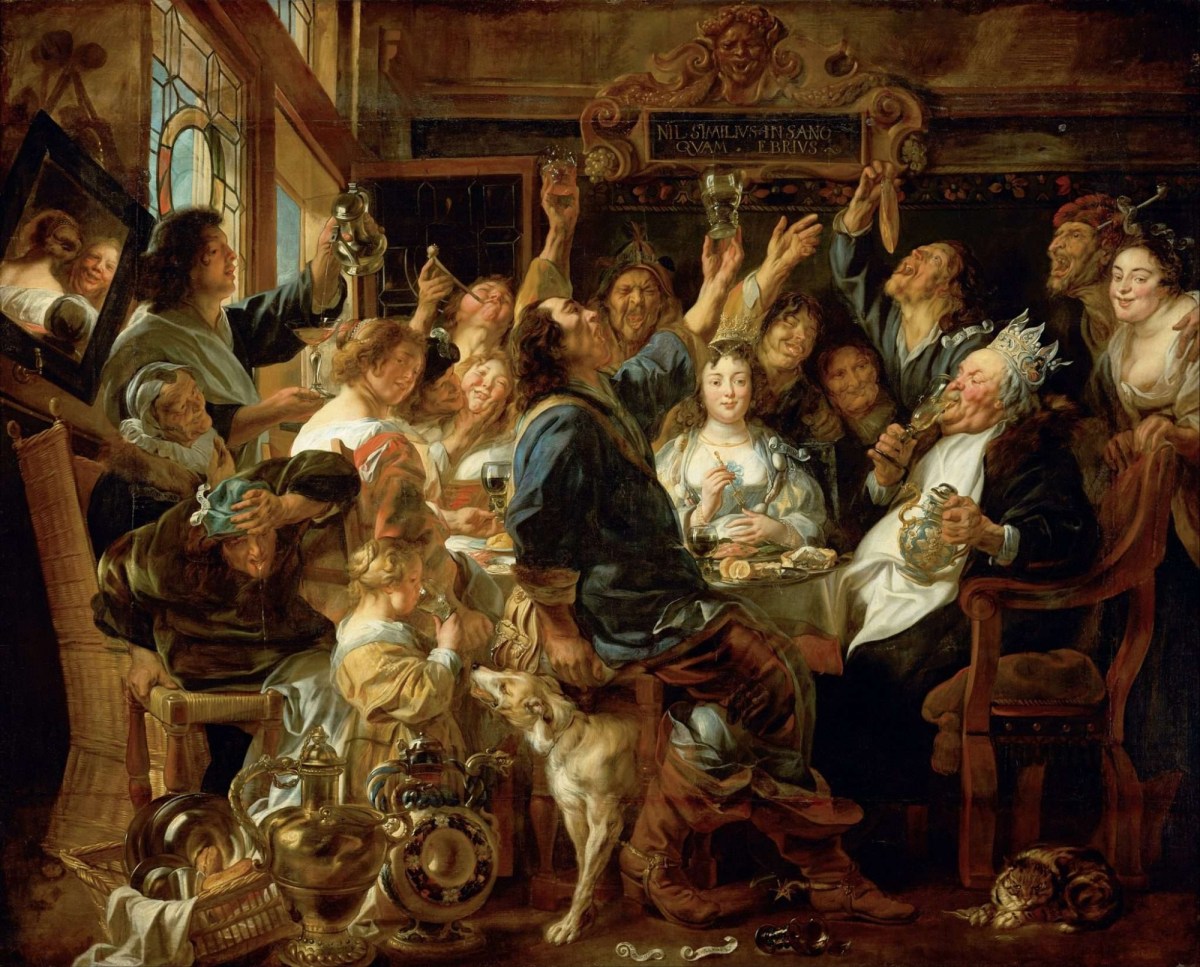
Our painting, The Feast of the Bean King, by Flemish painter Jacob Jordaens, depicts a lavish feast. A lively group is gathered around a well-laden table, led by an elderly man crowned king for the day. According to tradition, this honour was bestowed upon the person who found a hidden bean in the cake baked for the feast of Epiphany. Today, common folk played at being royalty, a playful release for dissatisfaction with the fundamental social order. The king’s primary duty was to raise his glass at intervals, prompting the company to follow suit with the cry, ‘The King drinks!’ Judging by the festive atmosphere, it’s clear this ritual has been enthusiastically repeated several times. Jordaens’s dynamic compositions owe much to the influence of Rubens, to whom he sometimes contributed. Still, he developed his distinctive style by blending his mentor’s techniques with exaggerated, burlesque figures. Above the scene is a moralising inscription: “nil similes insano quam debris”—“Nothing is more like a madman than a drunk.” This lavish banquet stands in sharp contrast to the banquet to which Jesus invites us: Jordaens’ temporal feast, filled with earthly pleasures, versus the eternal banquet that Jesus offers—a celebration of everlasting life.

You must be logged in to post a comment.